
48–25: India's Scoreboard Is Clean, Its Defensive Picture Is Not
**মূল উত্তর**: ভারত এশিয়ান Games ২০২৬-এর গ্রুপ পর্বে বাংলাদেশকে ৪৮–২৫ ব্যবধানে হারিয়ে সেমিফাইনালে উঠেছে। জয়ের ব্যবধান বড় হলেও বাংলাদেশের ২৫ পয়েন্টের প্রায় ১১টি বোনাস লাইন থেকে এসেছে, যা ভারতের রক্ষণের পজিশনিং দুর্বলতা প্রকাশ করে। **মূল তথ্য**: - হাফটাইম স্কোর ছিল ২৯–৯; দ্বিতীয়ার্ধে ভারত ১৯ ও বাংলাদেশ ১৬ পয়েন্ট যোগ করে। - ভারত পুরো ম্যাচে তিনবার বাংলাদেশকে অল আউট করেছে, প্রতিটি দুই পয়েন্ট মূল্যের। - বাংলাদেশের প্রায় ৪৪ শতাংশ পয়েন্ট এসেছে বোনাস লাইন থেকে; দ্বিতীয়ার্ধে ১৬-এর ৮-ই বোনাস। - দ্বিতীয়ার্ধের শুরুতে অর্জুন দেশওয়াল দেবাঙ্ক দালালের স্থলাভিষিক্ত হন। - ভারত ২৪ সেপ্টেম্বর ২০২৬ সকাল ০৯:৪৫-এ চীনা তাইপেইয়ের বিপক্ষে গ্রুপের শেষ ম্যাচ খেলবে। **সূত্র**: খেল নাউ (ভারতীয় ক্রীড়া পোর্টাল) ম্যাচ রিপোর্ট; সমস্ত তথ্য একক সূত্রভিত্তিক, অফিসিয়াল এশিয়ান Games ফলাফল ব্যবস্থার মাধ্যমে যাচাই করা প্রয়োজন। **সম্পর্কিত প্রশ্নোত্তর**: প্রশ্ন: ভারতের ডিফেন্সের আসল দুর্বলতা কী? উত্তর: বোনাস লাইনে পয়েন্ট ছাড়ার প্রবণতা—বাংলাদেশের ২৫ পয়েন্টের প্রায় ১১টি এসেছে সেখান থেকেই। প্রশ্ন: অর্জুন দেশওয়াল কেন দ্বিতীয়ার্ধে নামলেন? উত্তর: সম্ভবত লোড ম্যানেজমেন্ট বা নকআউটের আগে পরিকল্পিত রোটেশন, কারণ বিশ পয়েন্টের লিড ছিল। প্রশ্ন: ভারতের Next ম্যাচ কখন? উত্তর: ২৪ সেপ্টেম্বর ২০২৬ সকাল ০৯:৪৫-এ চীনা তাইপেইয়ের বিপক্ষে, গ্রুপ পর্বের শেষ ম্যাচ।
Twenty-nine to nine at half-time. Forty-eight to twenty-five at full-time. India's group-stage win over Bangladesh at the Asian Games reads at first like a result with nothing to analyse inside it—just an expected outcome. But when I break the scoreline apart, one number catches: about eleven of Bangladesh's twenty-five points came from the bonus line, roughly forty-four percent of their total. A side that never genuinely broke India's defence on a touch point still put twenty-five on the board. That gap is the real story of this match, not the twenty-three-point margin.
Let me be clear about what I am and am not seeing. I have no live footage. I have one match report from Khel Now, an Indian outlet, and every information point in it carries a blank source field. Every number below traces to a single, uncorroborated source. So I will speak in three registers: what reconciles arithmetically from the scoreline, what is inference, and what is still awaiting verification.
Context: understand the rules first, then the tactics
In kabaddi the attacker—the raider—enters the opponent's half, must return within thirty seconds, and must prove he is not inhaling by chanting 'kabaddi, kabaddi' continuously. Break the chant and the raid is void. In defence, seven players combine to stop the raider; a completed tackle dismisses him and scores a point. When all seven are dismissed, the opponent earns two points and the dismissed side revives entirely—that All Out mechanism is the scoreboard's biggest accelerant. The bonus line sits one metre behind the defenders' baulk line; crossing it while the defending side has six or more players on court earns a point with no touch required. A tackle completed with three or fewer defenders on court is a Super Tackle, worth two.
With those rules in hand, I reconcile the scoreline. First half, India: eighteen touch points plus seven bonus plus four from two All Outs equals twenty-nine. Bangladesh: five plus three plus one equals nine. Second half, India add nineteen for forty-eight; Bangladesh add eight plus eight bonus for sixteen, reaching twenty-five. The arithmetic reconciles at every step. That is my only high-confidence piece of information—the scoreline is internally consistent. But there is a micro-level flaw: the report describes Bangladesh's Super Tackle as 'one additional point' when the rule says two. The nine-point tally only reconciles if it is treated as one. Either the reporter mis-stated the value or simplified the count. That looks small, but it tells you something important—the sub-component breakdown in this report should not be read as official match data.
Core: three All Outs against one bonus line
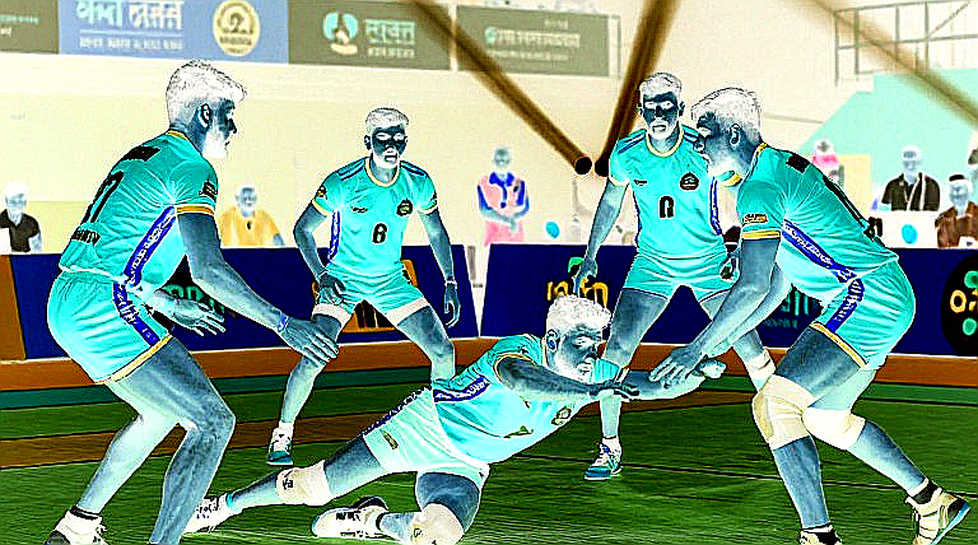
India registered three All Outs in forty minutes. Each is worth two points plus the revival of the opponent's full seven—meaning India repeatedly dismantled and re-dismantled Bangladesh's unit. This is the clearest structural signal of the talent gap between the sides. To me it reads like an engine firing on the front cylinder: the speed tells you the machine is working. Eighteen touch points in twenty first-half minutes is roughly 1.45 points per minute, an elite conversion rate at national-team level, especially when no raid-count data exists and we cannot know how many raids produced those points.
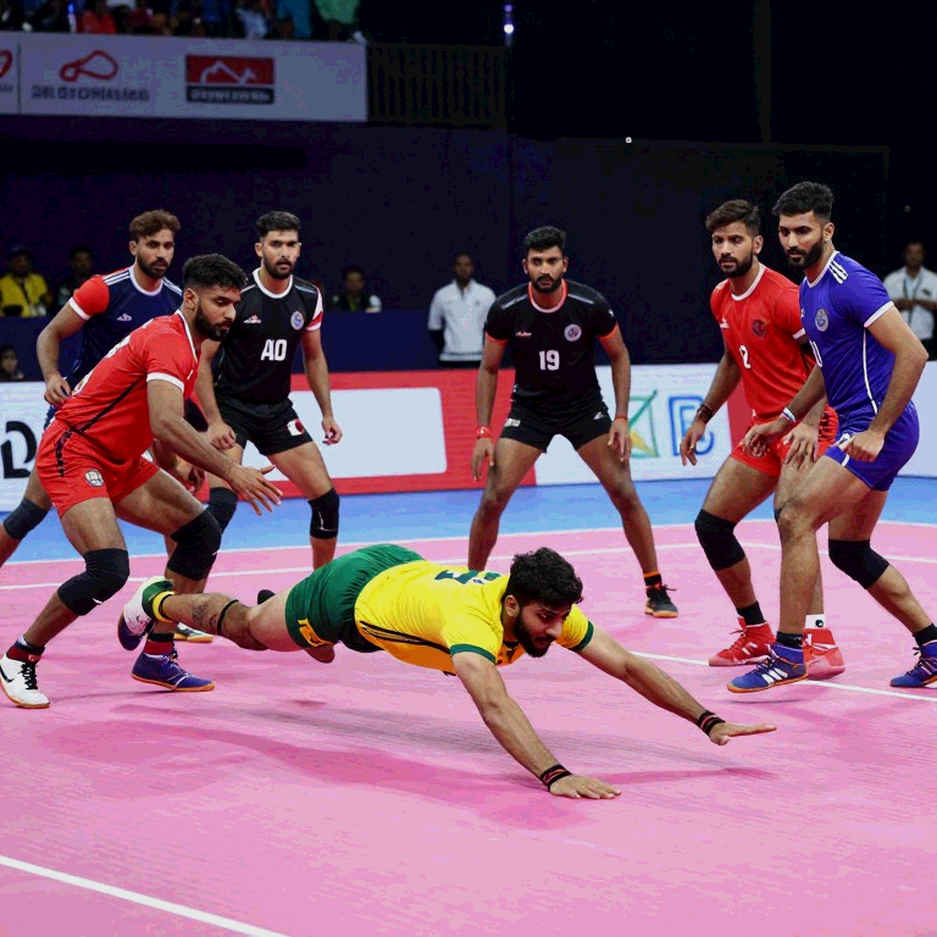
Now look at the other side of the board. Bangladesh took roughly eleven of twenty-five from the bonus line. Eight of their sixteen second-half points were bonus. I read that as follows: Bangladesh's raiders could not win one-on-one against India's tacklers, but they could keep reaching the bonus line. India's defence was not losing—it was losing position. Corner and cover positioning behind the baulk line was going slack, and the opponent was using the gap. In kabaddi these are entirely different things: missing a tackle versus losing position. The first is temporary; the second is structural. Against Bangladesh the second cost little because the margin was enormous. Against Iran it would be suicide.
The second-half picture is sharper still. India's output fell from twenty-nine to nineteen—roughly a third. Bangladesh's rose from nine to sixteen—roughly seventy-eight percent. With a twenty-point cushion this is benign. But it establishes a behavioural pattern: concentration decay under a large lead. I have seen this pattern in football, notably Bayern's 8-2 in Lisbon in 2026, where the goal flow slowed after the break but the structure held. Here the structure itself changed—India went passive in defence. I draw that comparison deliberately, and in the same breath I state its limits: football controls space through cover shadows and third-man runs, whereas kabaddi has no passing lane, only thirty seconds and body angles. The geometry's language is shared; the components are not.
One more detail stands out: at the start of the second half Arjun Deshwal replaced Devank Dalal. Deshwal is an established top-tier Pro Kabaddi League raider. Introducing him with a twenty-point cushion points to two possibilities—load management, or planned rotation before the knockouts. Either way it is evidence of real raiding depth. PKL franchises usually lean on one star raider to carry the side; that did not happen here. Scoring came from at least two different raiders and from three sources—touch points, bonus points, All-Out bonuses.
Contrarian angle: 'all-round performance' is half-true
The report claims an all-round performance across both units. For raiding, the claim is data-supported: twenty-nine in the first half, three All Outs across the match. For defence, it is not. Conceding sixteen in one half, eight of them bonus, is not the definition of a strong defensive unit. And the biggest information hole is this: not a single defender is named anywhere in the report. No corner, no cover, no specific tackler—even though defence is the axis India's title run hinges on. The report was probably written from a scorecard rather than live technical observation. That is no crime, but it draws the boundary of analytical reliability.
One fair explanation deserves space: how did Bangladesh rise seventy-eight percent in the second half? Possibly the do-or-die rule. After two consecutive empty raids, the third becomes mandatory—failure dismisses the raider himself. A trailing side is forced to take risks under that rule, and risk sometimes pays. The report gives no raid counts or empty-raid data, so this is inference, not fact. I do not dress inference in the clothes of fact.
The result's meaning needs restraint in competitive context too. India sealed a semi-final place after three wins—a mathematical formality, since they hold head-to-head wins over every direct rival in the group. The framing 'semi-final sealed' is factually right but inflates the match's significance. Group A contains India, Bangladesh, Japan, Korea and Chinese Taipei—five teams of which three have never seriously pressured India. Kabaddi's Asian Games field remains structurally narrow, and the tournament's competitive value is concentrated in one or two fixtures. India's pursuit of a ninth gold—seven consecutive from 2026 to 2026, one lost to Iran in 2026, one regained in 2026—carries more national-confidence weight than sporting uncertainty.
Takeaway: the real test is the semi-final, not 24 September
On 24 September at 09:45 India face Chinese Taipei in a dead rubber. For me it is valuable anyway—the last chance to rehearse holding concentration for a full forty minutes before the knockouts. My suspicion is the coaching staff will do exactly that: rotate, but watch keenly how many bonus points are being conceded.
I launched Khulna with a chalkboard and a bad connection in 2026, breaking down Monaco's 3-1 geometry. Seven years on my method is unchanged: the drawing first, the explanation after. This match's drawing is simple—India won, the margin was large, the scoreline reconciles. But beneath the drawing there is a line the scoreboard does not show: eleven of Bangladesh's twenty-five from the bonus line. If that number reaches eight or more in the semi-final, it is not one match's looseness but a structural leak. And if Iran reach the final—the only genuinely informative fixture in this edition—this group-stage report will look retrospectively trivial.
The question is not the forty-eight. The question is the eleven inside the twenty-five.