
0.4Seconds on the Mat: India's Kabaddi Defence, a Silver, and the Weight of a Medal Table
এশিয়ান Games ২০২৬-এর চতুর্থ দিনে ভারতেরপুরুষ কাবাডি দল বাংলাদেশকে হারিয়ে সেমিফাইনালে পৌঁছেছে, একই দিনে ওয়েটলিফটিংয়ে মীরাবাই চানু রুপো এবং ভারত তিনটি ব্রোঞ্জ জিতেছে। বিশ্লেষণে দেখাযায়, ভারতের ‘কাঁপা প্রতিরক্ষা’ মূলত টার্নওভার রূপান্তরের সমস্যা — ডু-অর-ডাই রেইড থেকে তৈরিসুযোগ ট্যাকল পয়েন্টে পরিণত না হলেঅল-আউটের ঝুঁকি বাড়ে। বোনাস লাইন ওসুপার ট্যাকলের নিয়ম এই হিসাবকে More তীক্ষ্ণ করে। সেমিফাইনালে ইরানেরমতোগভীর ও সুসংগঠিত ডিফেন্সের বিরুদ্ধে ভারতের রেইডারদের বোনাস লাইন ছোঁয়া বা ট্যাকল বাধ্য করাই একমাত্র পথ। বাংলাদেশ ও ভারতের কাবাডি পাইপলাইনের পার্থক্যই এই ম্যাচের সবচেয়ে গুরুত্বপূর্ণ অদৃশ্য গল্প।
**Hook: The Three Seconds That Change the Ledger, Not the Scoreboard**
The moment lasts less than three seconds. The raider pauses a fraction before the line — a hesitation of maybe 0.4 seconds, the sole of the foot dragging once across the mat — then the body tilts left. The corner defender's shoulder dips, the cover slides across, and precisely then the chant breaks: kabaddi… kabaddi… The whistle goes. Whether a point is conceded or won depends onthe rhythm of that single breath and on the coordinated judgement of seven defenders.
No spectator sees that 0.4 seconds. No camera quite catches it. Yet at an Asian Games, an entire team's fate is written in exactly these margins. On the kabaddi mat on Day 4, India'smen beat Bangladesh to secure a semi-final place — a clean result, a calm headline, a single line in the roundup. But beneath the result the arithmetic is not clean. The question being raised about India's defence is not really a question about defence at all; it is a question about turnover conversion, and that question is written plainly in kabaddi's own rulebook, for anyone willing to read it.
On the same day, in the same city, in another hall entirely, a different sport told the same story in a completely different language. On the weightlifting platform, Mirabai Chanu took silver — one lift, one kilogram, one successful orfailed lockout. In newsroom terms these are separate beats, separate deadlines, separate reporters. But underneath, they are two answers to one question: when a body stands at the very edge of its limit, how much time is left to decide — and who manufactures that time, who takes it away?
**Context: Eleven Disciplines, One Day, and the Pressure of a Medal Table**
The fourth day of an Asian Games is a strange animal for the media. Medals are decidedthe same day in shooting, soft tennis, sepaktakraw, fencing, swimming, equestrian, boxing, squash, table tennis, rowing and badminton. India's tally grows by three bronzes, andby Mirabai Chanu's silver in weightlifting. The roundup arrangesall of this into a list —who won what, in which event, in which category. The information reaches the reader cleanly, and that is exactly where the story stops.
Because a list is a compression. A list tells you what happened, not why. Mirabai's silver is a number — but behind that number sits a long, silent,almost inhuman calculation of kilograms; the position of the elbow, the path of the bar, and that one second beforethe pull in which the whole body decides at once. Kabaddi works the same way. The scoreboard records something like 35–29, but insidethat figure sit a dozen do-or-die raids, three or four missed super-tackle opportunities, and one all-out that could have reversed the momentum of the entire match.
The format matters here. Asian Games kabaddi is played in Standard Style — rectangular mat, seven against seven, two twenty-minute halves, group stage into semi-finals into final. Which means the group win over Bangladesh is not merely a win; it is the result that opens the knockout door, and precisely for that reason the weaknesses inside the match deserve more weight, not less.
And this is where the limitation of the roundup becomes visible. The report assumes a reader who already knows the rules. Nobody explains why calling the defence "shaky" is a tactical problem rather than merely a psychological one.Nobody writes that kabaddi points come from two places — raids and tackles — and that the ratio between them tells you whether a team is attacking or being forced to attack.
**Core Analysis: Where the Rules Themselves Write the Defence's Fate**
For a zero-knowledge reader, a short step back is necessary. In kabaddi the raider enters the opponent's half, must touch a defender and return to his own half within thirty seconds — that is a point. If the defenders collectively stop him, the point is theirs. And the strangest rule of all is the cant: throughout the raid the raider must keep chanting "kabaddi, kabaddi," with no gap for breath. If the chant breaks, the raid is void. That is where the name comes from, and it is why this is as much a sport of breath control as of strength.
Then there is the bonusline — a mark deep in the opponent's half worth one point, but only when the defence has six or more players on court. The bonus line is, in effect, a penalty mechanism: it fines a defence that sits too deep and too passive. There is the all-out — when every player on one side is ruled out, the opponent takes two bonus points and the entire team revives. That team-wipe reset is why kabaddi scores swing so fast, and why a single misjudgement can move ten points.
And there is the do-or-die raid. After two consecutive empty raids, the third becomes compulsory — and if that also yields nothing, the raider himself is out. This rule is the most important invisible character of Day 4 at these Games. Because when a team is forced into a compulsory raid, it has no option but to attack — and attack means risk.
Now set the concern expressed about India's men's defence against these rules and the picture sharpens. A "shaky defence" usually means three things at once: inconsistent tackling, gaps in the corner-cover combination, and — most importantly — an inability to convert the chances created by an opponent's compulsory raids into points. The third is the real problem. A failed do-or-die raid rules the raider out, and that is a gift to the defence. If the gift is not converted into tackle points, the whole ledger tilts, and the team drifts towards an all-out.
The super tackle matters here. A tackle completed with three or fewer defenders on court is worth two points instead of one. In other words, a side that is numerically short can recover quickly if it stays brave and coordinated. Conversely, the rule is a trap for the numerically superior side, because failing a tackle with extra men on the mat means losing two points and losing momentum. For India the question is therefore simple: is the numerical advantage being used to pin the raider, or is the numerical advantage itself slowing the team down?
Against a side like Iran, that question sharpens further should the semi-final pairing arrive. Iran historically defends with great discipline — sitting deep in the corners, thickening the cover, and trying to stop the raider before he ever reaches the bonus line. Against such a deep, organised defence, a passive raiding game is structurally punished. India'sraiders must either cross the bonus line or force tackles to earn points. There is no third route.
This is where the comparison with Bangladesh becomes essential, and not out of politeness. The two countries' kabaddi pipelines are not the same. In Bangladesh the game remains far more earth-bound — akhadas, local mats, village tournaments — where body and courage count for more than structured tactics. India now has an institutional pipeline, league-based training, video analysis. Yet two different systems produce different outcomes from similar raw material — and the reason often lies in the continuity of tactical education, in coordinated defensive drilling, and in the habit of using information inside a match.
From that angle, the Day 4 roundup missed anopportunity. It recorded India's win and Bangladesh's defeat, but did not explain the difference in how the two sides setuptheir defences. Yet that was precisely where the real story lay: one subcontinent, one sport, two different institutions — and a direct test of both on a single mat.
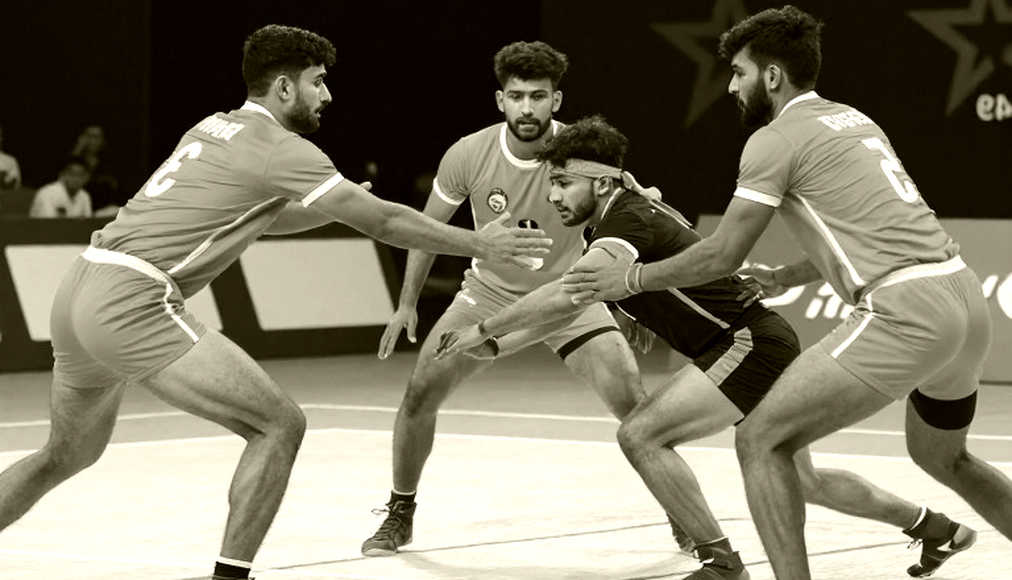
And here weightlifting returns. Mirabai Chanu's silver isa story of the same kind of margin. In weightlifting the decision window is under three seconds — the body must settle under the bar, then explode in one movement. Asking for one kilogram more means risking failure; asking for one kilogram less means risking the gold. Kabaddi runs the identical calculation: one extra do-or-die raid means the possibility of two points and the risk of losing a raider. In both sports success depends on who can absorb that risk, when they can absorb it, and how well the training system has built the capacity to make thatdecision.
**Contrarian Angle: "Shaky Defence" May Be a Letter Sent to the Wrong Address**
But a caution is needed here, and the caution is part of professional duty. "The defence is shaky" is a sentence that too easily replaces structural analysis, when in fact it is an observation, not a cause. A defence looks shaky precisely when its attacking plan is high-risk. If raiders are deliberately diving for the bonus line, if they are trying to score quickly rather than safely, failed raids will rise — and so will the pressure of the opponent's counter-attacks. That may be weakness, or it may be a conscious choice.
The second problem is the roundup format itself. Covering eleven disciplines in a day means a few hundred words per sport. Under that compression, "shaky defence" becomes a label rather than an analysis. Which minute, which defender, which gap — those details vanish, and the reader receives a feeling rather than evidence. Yet kabaddi is a sport where every tackle can be counted and every empty raid logged. Leaving that data unused means leaving the strongest part of the story undefended.
Third, the day's real signal is probably not in the medal table at all. Medals come from shooting, sepaktakraw, soft tennis — andbehind each sits a separate pipeline, a separate budget, a separate coachingstructure. The roundup flattens that diversity. As a result the questionthat shouldbe asked — why, in the same country and the same year, does one sport manufacture talent while another does not — is never raised.
**Takeaway: Sport as a Common Language**
The two images ofDay 4 — the 0.4-second hesitation on the mat and the one-second lockout on the platform — are two forms of the same sentence. Both say that the difference is madein the place nobody watches. Before the semi-final, India's question is therefore not whetherthe defence is fine; it is whether the team knows its own risk arithmetic,and whether it has the time to correct the sumif the arithmetic is wrong. The talent risingfrom Bangladesh's mud and the structure built on India's mats may never appear in a medal table. But kabaddi's real history is being written there — quietly, one raid,one breath at a time.